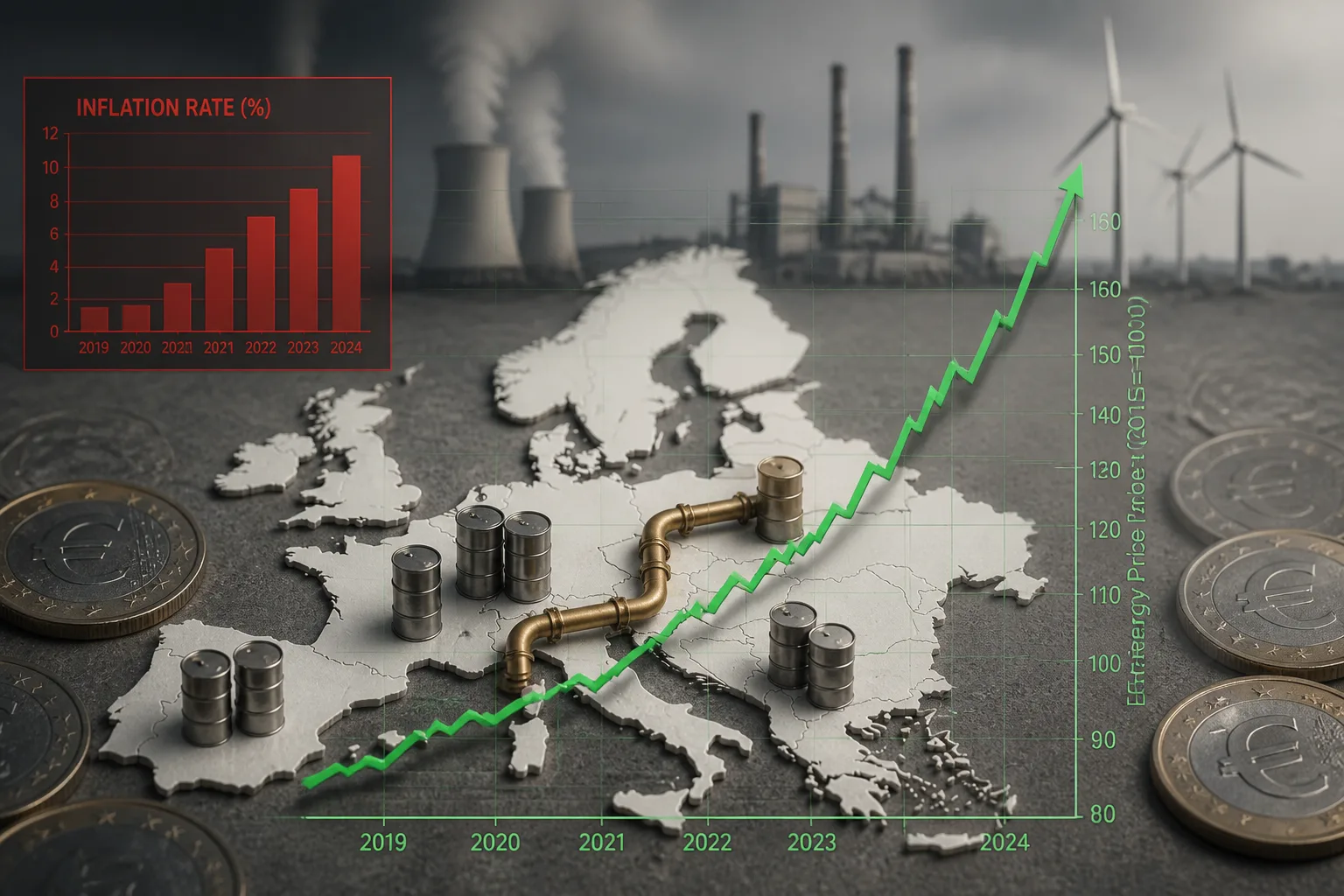
ECB Signals Higher Energy Prices Will Keep Eurozone Inflation Above Target into 2027
The European Central Bank (ECB) has warned that the ongoing conflict in the Middle East will keep inflation in the euro area above its 2 % target until the first half of 2027. In a speech to the European Parliament’s Committee on Economic and Monetary Affairs on 23 June 2026, Philip Lane, a member of the ECB Executive Board, said that the war’s energy shock would continue to press prices upward.
Lane noted that headline inflation rose to 3.2 % in May from 3.0 % in April, with energy inflation at 10.8 % year‑on‑year and core inflation at 2.6 %. The ECB’s staff baseline projections now expect headline inflation to average 3.0 % in 2026, 2.3 % in 2027 and 2.0 % in 2028. The higher energy costs are already reflected in forward‑looking indicators such as input prices, import prices, food‑chain pressures and selling‑price expectations.
Growth forecasts have been revised downward. The ECB now projects real GDP growth of 0.8 % in 2026, 1.2 % in 2027 and 1.5 % in 2028. Services activity has weakened more visibly than manufacturing, and the support that had come from precautionary inventory accumulation is fading as new orders stagnated in May.
The labour market remains resilient, with the unemployment rate at 6.3 % in April, close to a historical low. However, Lane said that labour demand has cooled further and that both firms and households expect the labour market to weaken in the near term.
In terms of policy, Lane said that incoming data on the intensity and duration of the energy shock justified a 25‑basis‑point increase in the ECB’s main policy rate in June. He added that the Governing Council would continue to adopt a data‑dependent, meeting‑by‑meeting approach and would not pre‑commit to a particular rate path.
The ECB’s statement also highlighted the asymmetric risks facing the euro area. “The risks to the growth outlook are to the downside while the risks to the inflation outlook are to the upside,” Lane said. The bank’s latest Economic Bulletin, released on 19 March 2026, confirmed that the Governing Council had kept the three key rates unchanged, citing the need to ensure inflation stabilises at the 2 % target in the medium term.
The Middle East conflict remains a key uncertainty for the euro zone. Lane said that the peace agreement was welcome but that the situation was still fragile, with the possibility of setbacks or renewed escalation. He added that the full implications for medium‑term inflation and growth would depend on the intensity and duration of the energy price shock and on the scale of its indirect and second‑round effects.
The ECB’s latest projections therefore reflect a cautious stance: higher energy prices are expected to keep inflation above target until mid‑2027, while growth is likely to stay modest. The bank will continue to monitor the evolving situation and adjust its policy stance as new data become available.
In the short term, the ECB’s 25‑basis‑point rate hike in June is intended to temper inflationary pressures while avoiding a sharp contraction in economic activity. The central bank’s focus remains on bringing inflation back to the 2 % target over the medium term, with no commitment to a specific future rate path beyond the data‑driven approach.
The ECB’s outlook underscores the importance of energy prices in shaping the euro area’s inflation trajectory and highlights the broader economic risks posed by geopolitical instability in the Middle East.