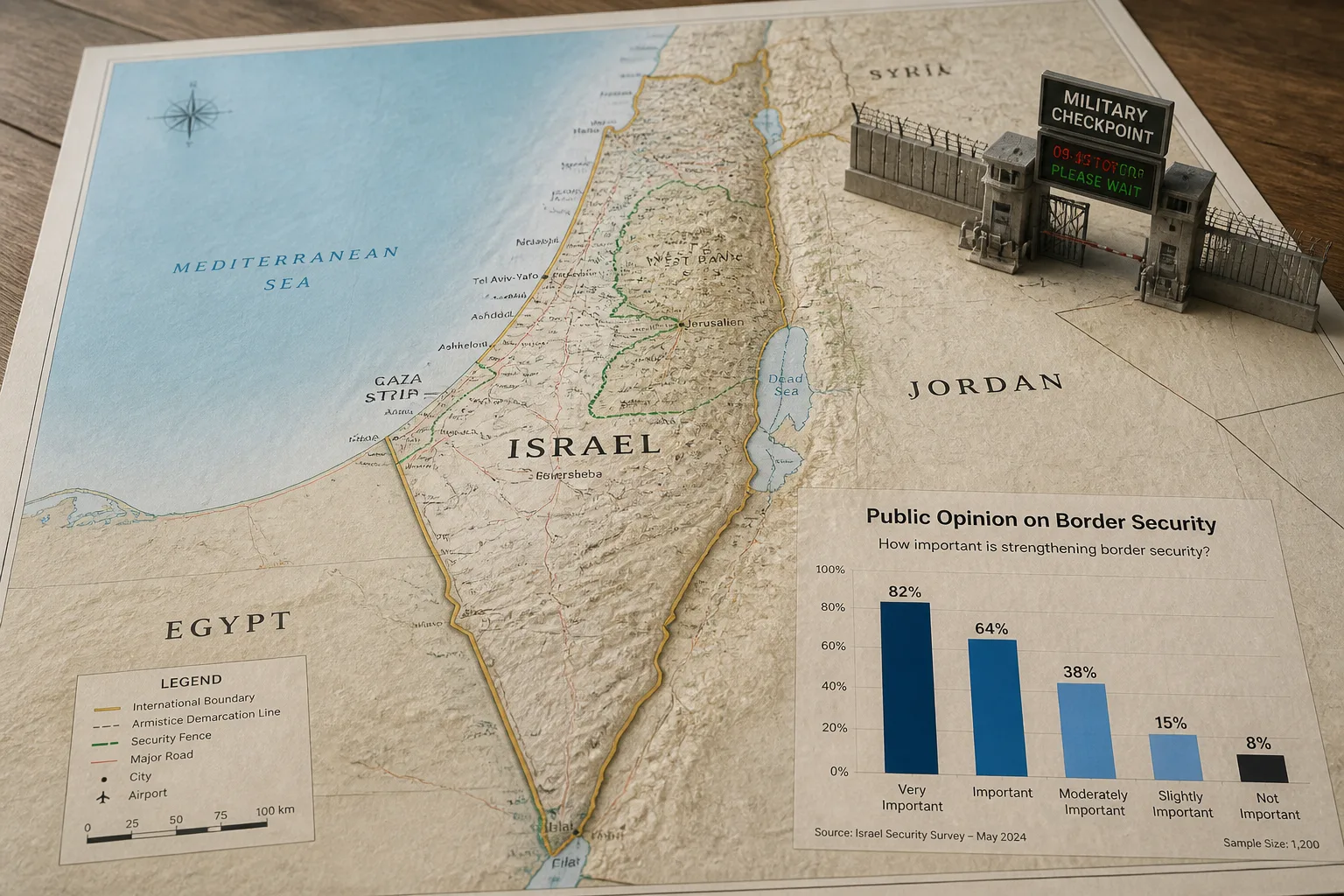
Israeli Public Opinion Survey Shows Strong Support for Defensible Borders and Military Buffer Zones
A nationwide public‑opinion survey carried out by Lazar Research under Dr. Menachem Lazar and released by the Jerusalem Center for Security and Foreign Affairs (JCFA) reveals that most Israelis now see the country’s borders as insecure and favor a robust military presence along key frontiers. The study, which sampled 503 Jewish and Arab adults, was conducted in the aftermath of the October 7 attacks by Hamas and the ensuing war in Gaza.
The survey found that 54 % of respondents believe Israel’s borders are not secure after the October 7 events, while only 42 % feel that the borders are adequately protected. Fifty‑six per cent said the security failure stemmed from several factors rather than a single mistake, underscoring a broad consensus that Israel’s defensive posture must be strengthened.
Gaza Buffer Zone A substantial 64 % of Israelis support establishing a permanent military buffer zone along the Gaza border, with an additional 11 % favoring a temporary arrangement. Roughly three‑quarters of the public therefore back a Gaza buffer zone, a position that could shape future policy discussions on the Strip and Israel’s security strategy.
Northern Front On the northern front, 73 % of respondents back maintaining an Israel Defense Forces (IDF) presence and a security zone in southern Lebanon up to the Litani River. Only 14 % oppose such a policy, indicating strong public backing for a buffer zone in that area.
Syria Sixty per cent of Israelis support keeping the current security presence in areas secured after the fall of the Assad regime, or expanding the buffer zone to address future threats. This reflects a willingness among the public to maintain strategic depth on the Syrian frontier.
Jordan Valley In Judea and Samaria, 57 % of respondents believe Israel must keep a permanent military presence in the Jordan Valley, viewing it as a non‑negotiable security requirement. Only 11 % think Israel could give up this presence.
International Security Guarantees The survey shows deep skepticism toward international forces. Sixty‑five per cent of Israelis do not trust foreign troops to replace the Israeli military along the borders. Of those, 40 % say only Israel can defend itself, while 25 % cite past failures by international forces.
Peace Agreements and Withdrawals A majority of respondents oppose a peace agreement that would require a full withdrawal from the West Bank without Israeli‑controlled buffer zones or security mechanisms. Sixty‑one per cent oppose such a plan, while only 27 % support it.
Historical Assessments The survey also reflects a reassessment of past territorial withdrawals. Forty‑eight per cent of Israelis now view the Oslo Accords as a strategic mistake, and 56 % believe that Israel’s 2005 disengagement from Gaza was also a strategic mistake.
Expert Commentary Dr. Dan Diker, President of JCFA, said: “The Israeli public has drawn a clear lesson from October 7 and the security developments of recent years: national security cannot be based on hopes, international guarantees, or assumptions that have proven inadequate. Most Israelis now understand that defensible borders, strategic depth, buffer zones, and an Israeli security presence in vital areas are indispensable components of national defense.” The study was conducted as part of the Defensible Borders Initiative of JCFA, in cooperation with the Jerusalem Institute for Strategy and Security (JISS).
Implications The survey’s findings suggest that Israeli decision‑makers face strong public pressure to maintain or expand military presence along the Gaza, Lebanon, Syria, and Jordan Valley frontiers. The data also indicate that Israelis are wary of relying on external security guarantees, which could influence future diplomatic negotiations and defense planning. The results provide a clear mandate for policymakers to prioritize defensible borders and strategic depth in Israel’s national security strategy.
Next Steps While the survey does not prescribe specific policy actions, it underscores a public consensus that could shape future debates on border security, buffer zones, and international cooperation. The JCFA and JISS will likely use these findings to inform policy recommendations and public discourse on Israel’s security posture.