Former Turkish Prime Minister Ahmet Davutoglu Dissolves Future Party, Exits Party Politics
On 29 July 2026, former Turkish prime minister Ahmet Davutoglu announced the dissolution of the Future Party (Gelecek Partisi) and his withdrawal from party politics. In a statement posted on X, he cited a "dirty political climate" in Turkey as the reason for stepping away.
Davutoglu framed the move as a moral decision rather than a surrender. He said he was not abandoning politics but urging a re‑evaluation of Turkey’s system. He warned that the executive presidential model introduced in 2018—after the prime minister’s office was abolished—has eroded checks and balances and accelerated authoritarian tendencies, potentially paving the way for a permanent authoritarian regime.
The party, founded by Davutoglu in December 2019 after his departure from the ruling Justice and Development Party (AKP), aimed to attract voters disillusioned with the AKP and to offer a conservative alternative with democratic credentials. However, it struggled to gain traction. In the 2024 local elections it captured only 0.11 % of the vote.
Davutoglu’s political path also took him into the opposition. He joined the Table of Six coalition—a grouping of six opposition parties—and backed Kemal Kılıçdaroğlu, chairman of the Republican People’s Party (CHP), in the 2023 presidential election. That alignment weakened his standing among conservative voters who had traditionally been wary of the CHP’s secularist positions.
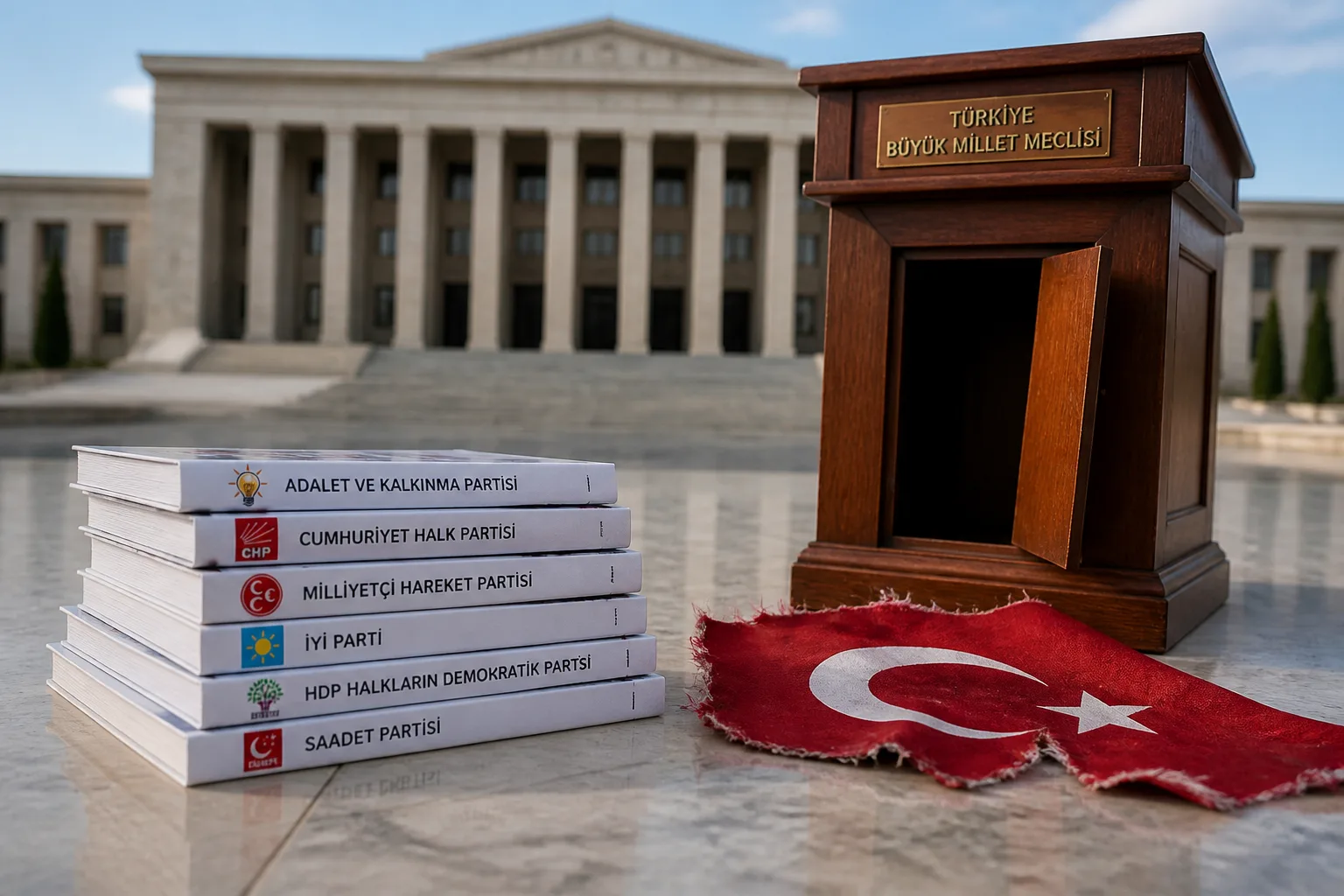
In the 2023 general election the Future Party secured ten seats in the Turkish Grand National Assembly. A series of defections to the AKP and other opposition parties has reduced its representation to four MPs. The party has also faced financial difficulties that have hampered its organisational sustainability.
Ankara‑based political sources report that Davutoglu had negotiated a potential merger with the AKP, but President Recep Tayyip Erdoğan opposed the inclusion of Davutoglu and former AKP official Selçuk Özdağ. The talks collapsed.
Davutoglu’s earlier career was marked by a close relationship with Erdoğan. He served as foreign minister from 2009 to 2014 and as chief adviser to Erdoğan from 2003 to 2009. He became prime minister in 2014, a position he held until his resignation in May 2016. Tensions between the two men grew after the 2015 snap election, when Davutoglu led the AKP to a parliamentary majority. He was removed from office in 2016 and further sidelined after the 2018 presidential election.
The closure of Istanbul Şehir University in 2020, founded by Davutoglu, deepened the rift between him and the current government.
Davutoglu’s exit marks the end of a political career that spanned more than a decade in Turkey’s ruling party and a brief period as prime minister. His statement underscores concerns about the concentration of power in the presidential system and the erosion of democratic institutions.
The Future Party’s dissolution leaves the Turkish opposition without a party that had positioned itself as a conservative alternative to the AKP. The remaining opposition parties will need to decide how to fill the gap in the political landscape.
The announcement comes amid a highly polarized political environment. The ruling AKP has maintained a majority in parliament, while the opposition coalition continues to push for a return to a parliamentary system and stronger checks on executive power.
In the coming weeks, observers will watch how the dissolution of the Future Party affects the balance of power in the Turkish parliament and whether it will influence the strategies of the opposition parties in future elections.