US-Iran Escalation Continues: Drone and Missile Strikes Hit Gulf Allies, Oil Prices Rise Marginally
On Sunday night, the Strait of Hormuz erupted into renewed hostilities as U.S. forces struck Iranian facilities while Iranian drones and missiles targeted U.S. allies Oman, Kuwait, Qatar and Bahrain. The attacks, which extended well into the night, prompted outrage from the affected Gulf states.
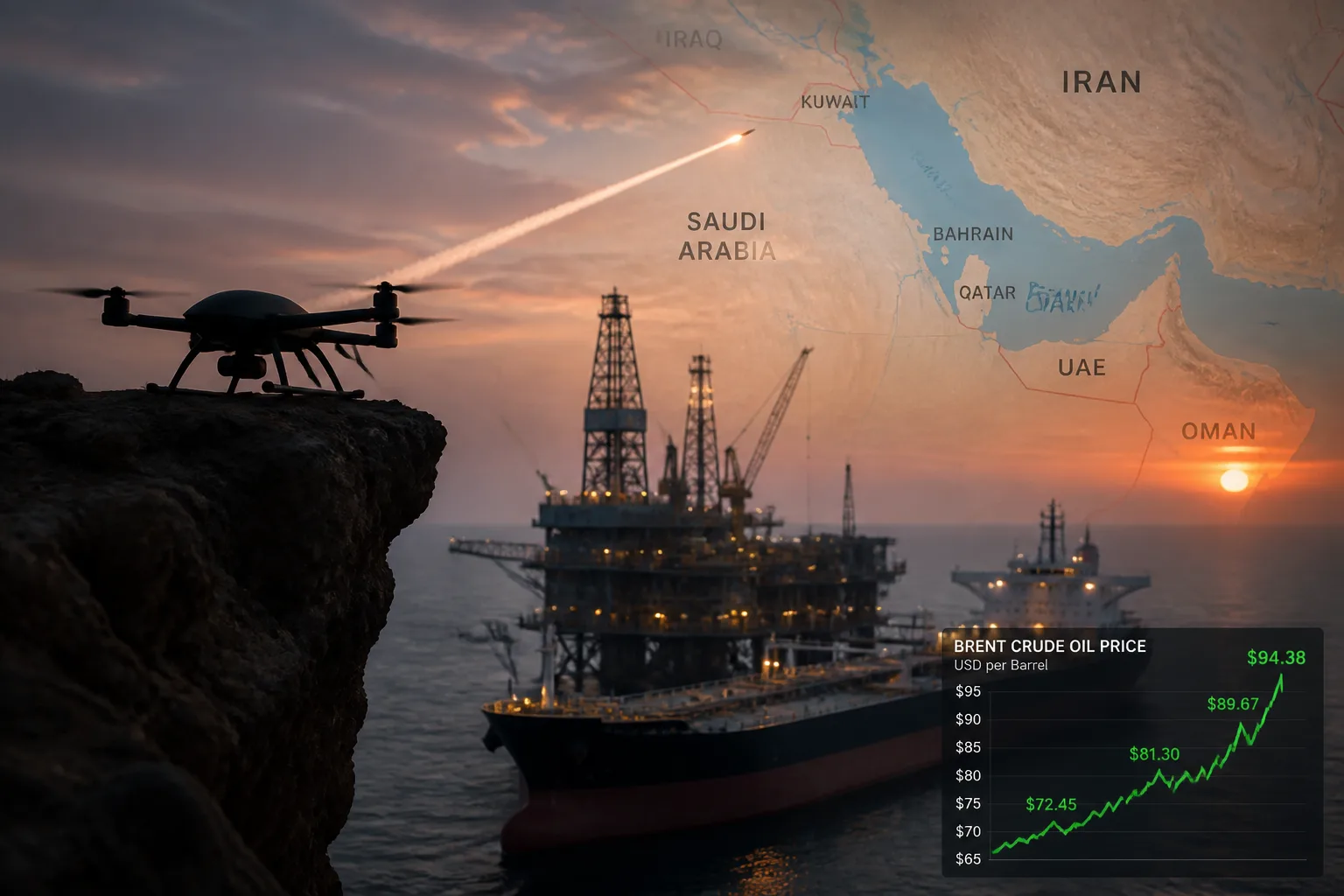
Kuwaiti officials reported that a hostile drone breached maritime airspace and struck an offshore drilling platform operated by the state‑run Kuwait Oil Company. The strike caused structural damage and injured one employee, the Kuwait Ministry of Defence said. The same day, the ministry also confirmed that three northern border centres had been hit, though it did not specify the type of attack.
Qatar’s government described the Iranian strikes as a “dangerous escalation.” The country’s Ministry of Foreign Affairs issued a statement condemning the attacks and warned that they crossed “many red lines.” Bahrain and Oman also issued statements condemning the strikes and calling for restraint.
The U.S. military confirmed that it had launched air strikes against Iranian targets in the Persian Gulf in response to Iranian attacks on commercial shipping. According to U.S. officials, the strikes hit several Iranian facilities, including a port and a missile launch site. The U.S. said the operations were aimed at degrading Iran’s ability to threaten shipping.
The latest round of fighting began last week when Iran fired shots at merchant vessels attempting to transit the Strait of Hormuz. A Cyprus‑flagged containership was hit by a missile and a swarm of drones. The attack damaged the ship’s engine room, which caught fire. One crew member went missing; the rest of the crew was rescued by the ship’s crew and a nearby U.S. naval vessel. The incident was reported by U.S. military officials.
Oil markets have reacted only modestly to the flare‑up. WTI crude rose by about 3‑4 %, trading around $73 a barrel, while Brent crude climbed to roughly $79 a barrel. Analysts attribute the limited price movement to the short duration of the strikes and the continued flow of shipping through the strait.
The current confrontation is part of the broader 2026 Iran war, which began on 28 February 2026 when the United States and Israel launched a joint attack on Iranian targets, including the assassination of Iran’s supreme leader. After months of hostilities, the U.S. and Iran agreed to a ceasefire on 14 June 2026, mediated by Pakistan and Qatar. The ceasefire was extended for 60 days to allow for a final settlement.
Oman has been a key mediator in the crisis. The country’s Sultan met with Iran’s foreign minister in Muscat to discuss security in the strait and to facilitate the safe passage of commercial vessels. Oman’s mediation efforts have been praised by Gulf allies, though the region remains tense.
The attacks on Kuwait’s border centres and offshore platform highlight the vulnerability of Gulf infrastructure to drone and missile threats. Kuwait’s oil industry is a critical component of the country’s economy, and any disruption could have wider economic repercussions.
Qatar’s condemnation of the Iranian strikes reflects its strategic position as a U.S. ally and a major exporter of liquefied natural gas. The country’s security concerns are heightened by its proximity to Iran and its role in regional energy markets.
Bahrain and Oman, both hosts to U.S. military bases, have expressed concern that the escalation could spill over into broader regional conflict. The U.S. has reiterated that it will defend its allies and maintain freedom of navigation in the strait.
The situation remains fluid. While the U.S. and Iran have agreed to a temporary ceasefire, the recent attacks suggest that hostilities could resume if diplomatic efforts fail to address the underlying security concerns of Gulf states.
In summary, the Strait of Hormuz has become a flashpoint again as U.S. and Iranian forces exchange strikes. Gulf allies have suffered drone and missile attacks, prompting diplomatic protests and calls for restraint. Oil prices have risen only modestly, reflecting the limited duration of the conflict. The broader 2026 Iran war continues to shape the security and economic landscape of the Middle East, with Oman playing a central role in mediation efforts.