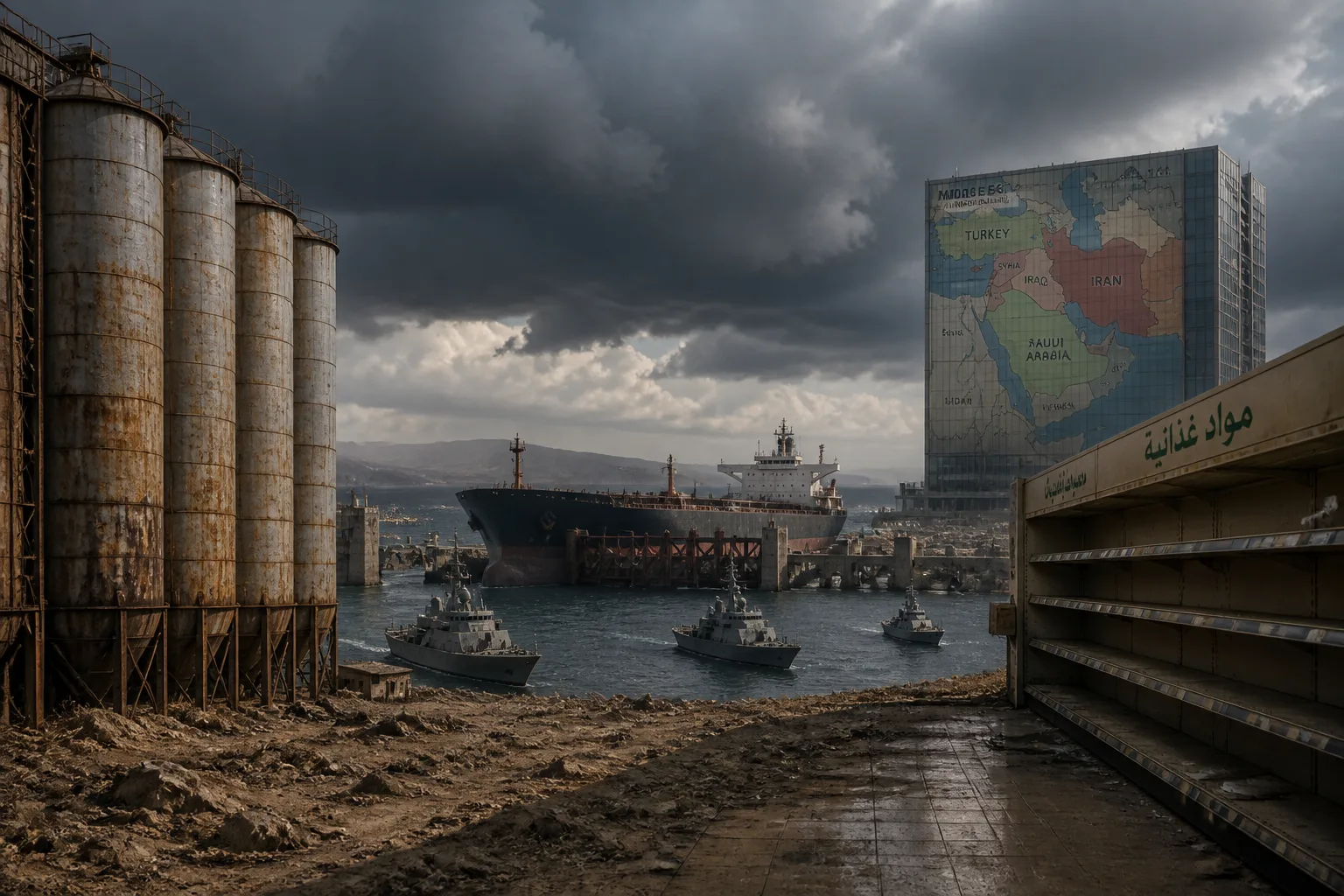
Strait Closure and the U.S.-Israel-Iran War Threaten Arab Food Security, Phenix Center Report Finds
When the world's shipping lanes froze, the ripple was felt far beyond the Persian Gulf, reaching the heart of the Arab food system.
On 1 June 2026 the Phenix Center for Economic and Informatics Studies published Assessing the Food Security Implications of the U.S.–Israeli War against Iran, a study that maps the war’s impact on energy, fertilizer, and maritime transport markets and how those shocks threaten food security across the Arab world.
The report notes that the 14 June 2026 Memorandum of Understanding between the United States and Iran, brokered by Pakistan and Qatar, has begun to ease tensions. The gradual reopening of the Strait of Hormuz has restored some maritime traffic, but the Center stresses that the risks of war‑related disruptions remain. The closure had halted the passage of 20 % of global liquefied natural gas and 25 % of seaborne oil, and it also cut the flow of key fertilizer inputs such as urea, ammonia, sulphur and phosphate.
According to the Phenix Center, the war threatens food security through five main channels: 1. Energy price spikes – Higher oil and gas costs raise the operating costs of irrigation pumps, farm machinery, transport and refrigeration. 2. Fertilizer supply shocks – Nitrogen fertilizers depend on natural gas; the Strait closure has limited both production and export of urea and ammonia. 3. Maritime transport disruptions – Shipping delays, higher freight and insurance premiums, and route changes increase the cost and time required to bring food and inputs to market. 4. Inflation and currency swings – Many Arab countries import food priced in U.S. dollars; a stronger dollar and higher commodity prices erode purchasing power. 5. Fiscal pressure on governments – Rising import bills strain budgets that fund food subsidies, strategic reserves and social protection programmes.
The Arab region is particularly exposed because it imports about 65 % of its cereal consumption and relies heavily on imported vegetable oils, animal feed and fertilizers. Water scarcity, limited arable land, climate change and weak domestic agriculture amplify this dependence. Gulf states, while financially resilient, still depend on maritime routes and energy‑intensive desalination. Mashreq countries such as Jordan, Iraq, Lebanon and Palestine face compounded risks from water shortages, fiscal constraints and declining purchasing power. North African states – Egypt, Morocco, Tunisia, Algeria and Libya – are experiencing rising costs for cereals, energy and transport.
Fragile states and those affected by ongoing conflicts – Yemen, Sudan, Palestine, Lebanon and Syria – are at the greatest risk. The war does not create a new food crisis but deepens pre‑existing vulnerabilities caused by displacement, weak institutions and shrinking humanitarian funding. Higher fuel and transport costs also raise the expense of delivering aid.
The Center concludes that the duration of the crisis will determine its severity. Short‑term disruptions may raise prices but can be contained; a multi‑season shock could reduce fertilizer use, lower crop yields and sustain higher food prices.
To mitigate these risks, the report recommends a multi‑level strategy: diversify import sources for food and fertilizers; expand strategic reserves; strengthen social protection systems; foster Arab cooperation on supply‑chain management; invest in climate‑smart agriculture and water‑saving irrigation; reduce food loss and waste; support small farmers; and enhance early‑warning and market‑monitoring systems. It also stresses that stable navigation through the Strait of Hormuz and a consolidated reopening are essential for easing pressures on food, energy and trade.
As of 21 June 2026 the Strait remains partially open, with some vessels still rerouted to avoid the region. The United States and Iran have agreed to a 60‑day cease‑fire extension, during which negotiations on nuclear limits, sanctions relief and asset release continue. The Arab world watches closely, as any escalation could quickly ripple through the global food system.